Battery Energy Storage System Market
According to a new comprehensive report from The Insight Partners, the global battery energy storage system market is observing significant growth owing to the rising popularity of battery energy storage systems in renewable energy projects.
The report runs an in-depth analysis of market trends, key players, and future opportunities. Types of battery energy storage system include lithium ion and others. Energy producers, transmission system operators, storage providers, and end users are stakeholders involved in the global battery energy storage system ecosystem.
Overview of Report Findings
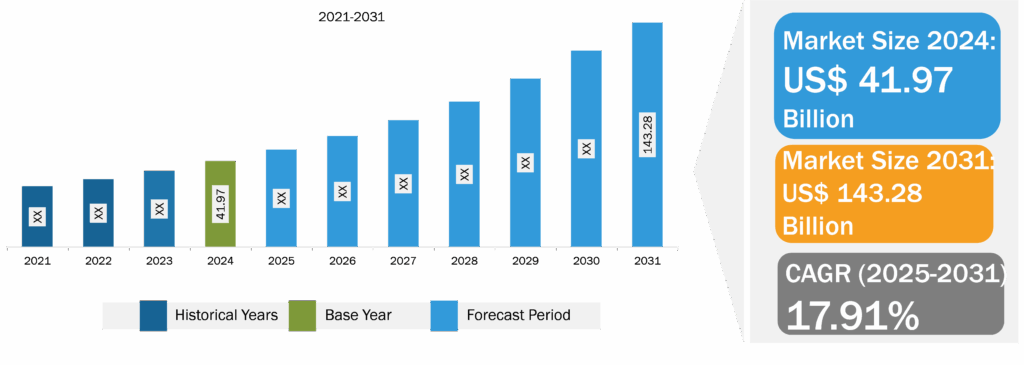
- Market Growth: The battery energy storage system market size is projected to reach US$ 143.28 billion by 2031 from US$ 41.97 billion in 2024. The market is expected to register a CAGR of 17.91% during 2023–2031. The changing energy circumstances across the globe are generating a demand for energy storage infrastructure. The growing energy demand displays the significance of energy storage systems. The storage system allows energy storage and its usage as per the requirement. Battery energy storage is also important owing to the required balance of energy supply. Developments in energy storage systems and an increase in research and development in energy management systems are driving the battery energy storage system market. For instance, in the US, Stor4Build, an association on energy storage for buildings, is working to accelerate the optimization and deployment of storage technologies. In January 2024, Plus Power stated that it initiated operation at its Kapolei Energy Storage facility in Oahu, Hawaii. The plant is equipped with a grid-scale battery energy storage system, helping in the transition of the state’s electric power from coal to solar and wind. In June 2024, Plus Power started managing seven large-scale battery energy storage plants across Arizona and Texas for a total of 1,325 MW/3,500 MWh. Thus, the growing focus of countries on building a vigorous storage infrastructure is driving the battery energy storage system market in the world.
- Mounting Demand for Energy: Rising population and growing urbanization are a few factors steering the use of energy globally specifically in countries such as the US, China, India, and Japan among others. As per the US Energy Information Administration (EIA), US energy consumption is anticipated to grow by 2050 owing to economic and population growth. EIA also reported that US electricity end-use consumption was ~3.2% higher in 2022 than in 2021. Further, EIA predicted that US power consumption will rise by 0.7% in 2025. Battery energy storage has the potential application as energy storage used in times of crisis or in remote or distant locations where power networks are not available. Furthermore, due to the increasing energy uncertainties worldwide, the US government is boosting the application of battery energy storage. For instance, in May 2024, Plus Power secured a US$ 82 million tax equity investment from bank Morgan Stanley for the Arizona-based 90 MW/360 MWh Superstition BESS project, which is anticipated to be operational in June 2024. In February 2024, RWE completed the construction of three new battery energy storage systems (BESS) totaling 190 MW (361 MWh) in Texas and Arizona.
- Growing Investment in Renewable Power Generation: Since over 70% of greenhouse gas emissions come from the energy sector, an EMS is an effective tool in the fight against CO2 emissions as per the EIA. A battery energy storage system boosts the usage of renewable energy during peak periods and thus reduces dependence on fossil fuels. The load optimization process ensures a device operates at peak efficiency, preventing energy wastage and lowering emissions. In addition, an EMS facilitates the seamless integration of renewable power sources, including solar and wind, into the power grid. By prioritizing renewable energy when available, BESS minimizes reliance on fossil fuels, which are the primary contributors to carbon emissions. Efficiency is an important measure for reducing energy demand in the Net Zero Emissions by the 2050 scenario and has made progress in recent years. However, to achieve this target, the rate of improvement in global energy intensity must be higher than in the past.
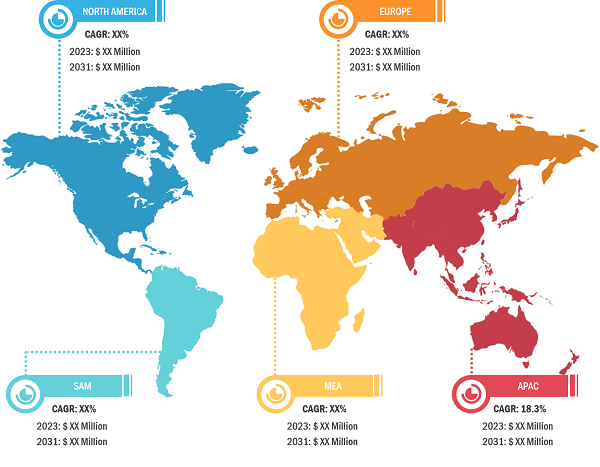
- Geographical Insights: In 2023, North America led the market with a substantial revenue share, followed by Europe and Asia Pacific. Asia Pacific is expected to register the highest CAGR during the forecast period.
Market Segmentation
- Based on type, the battery energy storage system market is divided into lithium ion and others. The lithium ion segment held the largest share of the market in 2024.
- Based on connection type, the battery energy storage system market is segmented into on-grid and off-grid. The on-grid segment dominated the market in 2024.
- Based on end user, the battery energy storage system market is segmented into commercial, utilities, and residential. The utilities segment dominated the market in 2024.
- The battery energy storage system market is segmented into four major regions: North America, Europe, Asia Pacific, and Rest of World.
Competitive Strategy and Development
- Key Players: A few major companies operating in the battery energy storage system market include BYD Co. Ltd; Saft America Inc.; CATL; Tesla Inc.; Samsung SDI Co Ltd; Panasonic Holdings Corp; AES Corp; NextEra Energy, Inc.; Ameresco Inc.; ESS, Inc.; Siemens AG; EOS Energy Enterprises Inc.; KORE Power Inc.; General Electric Co; LG Chem Ltd.; SAFT Groupe SA; and ESS Inc.
- Trending Topics: Batteries for Solar Energy Storage Market
Global Headlines on Battery Energy Storage System
- “General Motors and Samsung SDI Plan to Invest More than $3 Billion to Expand U.S. Battery Cell Manufacturing “
- “SAMSUNG SDI Introduces Next-Generation ESS Battery Solutions at Renewable Energy Plus 2024”
- “AES Hawaii Launches Company’s First Solar plus Storage Facility on O‘ahu.”
- “Ameresco to build 50MW/200MWh BESS in California.”
- “Ameresco and Southern California Edison Reach Agreement on Substantial Completion Milestone for Two Battery Energy Storage Projects”
Conclusion
Asia Pacific is projected to register a highest CAGR from 2023 to 2031. The APAC battery energy storage system market is segmented into Australia, India, China, Japan, South Korea, and the Rest of APAC. The region is emerging as a key player in the global battery energy storage system market. As the region’s economies, particularly China and India, continue to grow, there is a rising interest in the development of renewable energy projects, which is driving the demand for battery energy storage systems. Moreover, the rapid economic development and ongoing urbanization are driving the economic growth within Asia Pacific.
The report from The Insight Partners, therefore, provides several stakeholders—including raw material providers, manufacturers, and end users—with valuable insights into how to successfully navigate this evolving market landscape and unlock new opportunities.