GNSS Chip Market
According to a new comprehensive report from The Insight Partners, the GNSS chip market is observing significant growth owing to the surging need for accuracy in real-time data and rising demand for 5G network and high-speed internet.
The report runs an in-depth analysis of market trends, key players, and future opportunities. In general, the GNSS chip market is segmented on the basis of type and end user, which are expected to register significant growth in the coming years.
Overview of Report Findings
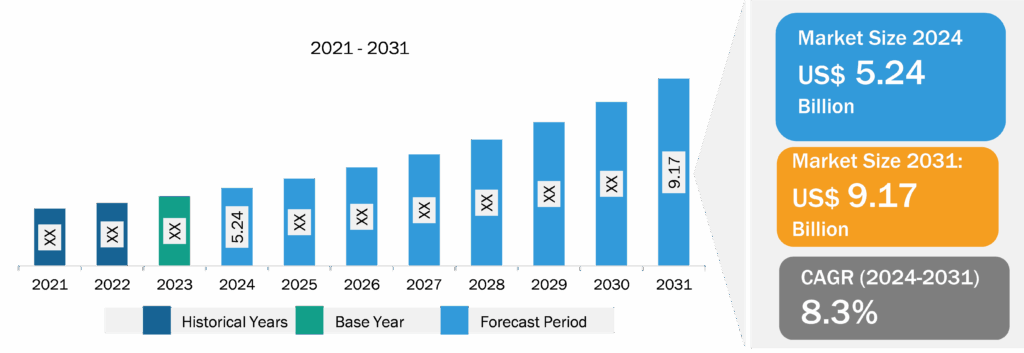
- Market Growth: The GNSS chip market was valued at US$ 5.24 billion in 2024 and is projected to reach US$ 9.17 billion by 2031; it is expected to register a CAGR of 8.3% during 2024–2031. Consumer electronic devices such as smartphones, smart wearables, digital cameras, and tablets use GNSS technology for mapping, geo-marketing, and navigation applications. GNSS chips are majorly being integrated into these devices to offer precise locations to users while running, walking, or driving. This feature has propelled the adoption of various location-based services (LBS) and applications. Several market players have been developing GNSS-based wearable devices. In June 2022, Quectel Wireless Solutions—a global IoT solutions provider—announced the release of its LC76G module, a compact single-band ultra-low power GNSS module featuring fast and accurate location performance. In addition, in July 2022, the US chip supplier Qualcomm released two new system-on-chip (SoC) platforms—the Snapdragon W5+ and W5—for wearable devices. The platform uses GNSS for GPS connectivity, resulting in an increased demand for GNSS chips.
- Rising Use of IoT Technology in Autonomous Vehicles: IoT technologies create advanced solutions such as advanced driver-assistance systems (ADAS), connected car solutions, in-vehicle infotainment systems, and navigation and telematics solutions. Navigation systems are mainly being deployed in vehicles for tracking purposes and to display maps that offer information about speed, location, direction, nearby streets, and points of interest. IoT-enabled cars have GNSS chips integrated into them, which help drivers drive efficiently, and concerned agencies can track their location during emergencies. In October 2023, u-blox launched u-safe, a vehicle positioning safety solution to accelerate autonomous vehicle adoption. U-safe uses proven automotive navigation components to offer Tier 1 suppliers and OEMs a reliable ADAS positioning solution. Moreover, the idea of autonomous vehicles is becoming a reality due to advancements in positioning and sensor integration technology. Fully autonomous vehicle needs an accurate localization solution to drive appropriately. High-precision GNSS technology provides key advantages, including reliability, accuracy, and precision required for self-driving vehicles. Thus, the rise in the demand for IoT-enabled cars is expected to create growth opportunities for the GNSS chip market in the coming years.
- Surging Need for Accuracy in Real-Time Data: Real-time, accurate location data is crucial for various navigation and mapping applications, including ride-hailing services, delivery drones, and precise driving directions. GNSS chips enable these applications by providing real-time positioning information. High accuracy in surveying operations can be attained with the help of sophisticated data processing software, integrated sensor systems, and high-end GNSS receivers with multi-constellation and multi-frequency capabilities. GNSS surveying technologies offer a wide range of accuracy levels and approaches to satisfy the needs of many applications. Single point positioning (SPP) offers simple location; real-time kinematic (RTK) and post-processing kinematic (PPK) offer centimeter-level precision, and differential global positioning system (DGPS) enhances accuracy. Owing to its lower latency and real-time corrections, RTK stands out as the most accurate approach. Through the utilization of various GNSS surveying techniques, experts can guarantee precise outcomes for their projects.
Market Segmentation
- Based on device, the GNSS chip market is divided into smartphones, tablets, personal navigation devices, in-vehicle systems, and others. The smartphones segment dominated the market in 2024.
- In terms of application, the GNSS chip market is divided into navigation & location-based services, mapping and surveying, telematics, timing & synchronization, and others. The navigation & location-based services segment dominated the market in 2024.
- Based on vertical, the GNSS chip market is segmented into consumer electronics, automotive & transportation, military and defense, marine, and others. The consumer electronics segment dominated the market in 2024.
Competitive Strategy and Development
- Key Players: Major companies operating in the GNSS chip market include Qualcomm Inc, Broadcom Inc, Septentrio NV, Trimble Inc, Furuno Electric Co Ltd, MediaTek Inc, STMicroelectronics NV, Skyworks Solutions Inc, u-blox Holding AG, and Quectel Wireless Solutions Co Ltd.
- Trending Topics: Automotive GNSS chip market, IC chip market, and AI chip market, among others
Global Headlines on GNSS Chip
- Septentrio collaborated with Xona Space Systems to develop an experimental GNSS receiver that is compatible with Xona multi-frequency PULSAR signals.
- Trimble unveiled Trimble IonoGuard, a next-generation system that reduces performance impacts from GNSS signal noise or scintillation in order to manage ionospheric interruptions in positioning and navigation.
Conclusion
Europe held a significant share of the GNSS chip market, and Germany accounted for a substantial share in the regional market, followed by the UK and France. Future growth perspectives include multi-GNSS applications and user uptake in Central and Eastern Europe. GNSS is the leading means of obtaining position, navigation, and timing (PNT) information at sea. Multi-GNSS solutions are favored, with Europe being the third-largest worldwide market for maritime GNSS devices. In addition, flights are designed to use performance-based navigation (PBN), and already more than 460 EGNOS-enabled approaches are operational in Europe. Thus, the increasing penetration of GNSS systems in the aviation sector is expected to positively influence market growth.
Several European countries have initiated projects to develop advanced UAVs, as the attainment of technology from abroad compromises the EU’s industrial autonomy. The “Euro drone Project” is one of the major projects in the region backed by the European Defense Agency; the project aims to provide a European MALE UAV by 2025. Germany, France, Italy, and Spain are among the countries at the forefront of these developments.
The report from The Insight Partners, therefore, provides several stakeholders—including component providers, product manufacturers, and end users—with valuable insights into how to successfully navigate this evolving market landscape and unlock new opportunities.